Quick Answer: In Southwest Florida, the person signing, the address where the signing happens, the property the paperwork describes, and the office that eventually receives it can sit in four different counties. None of that is unusual, and none of it changes what a notary is allowed to do. What changes is the planning, because each step is governed by a different address. Searches that read “mobile notary multiple counties Florida” usually arrive at the same set of questions, one document at a time.
Why One Signing Can Involve Four Different Counties
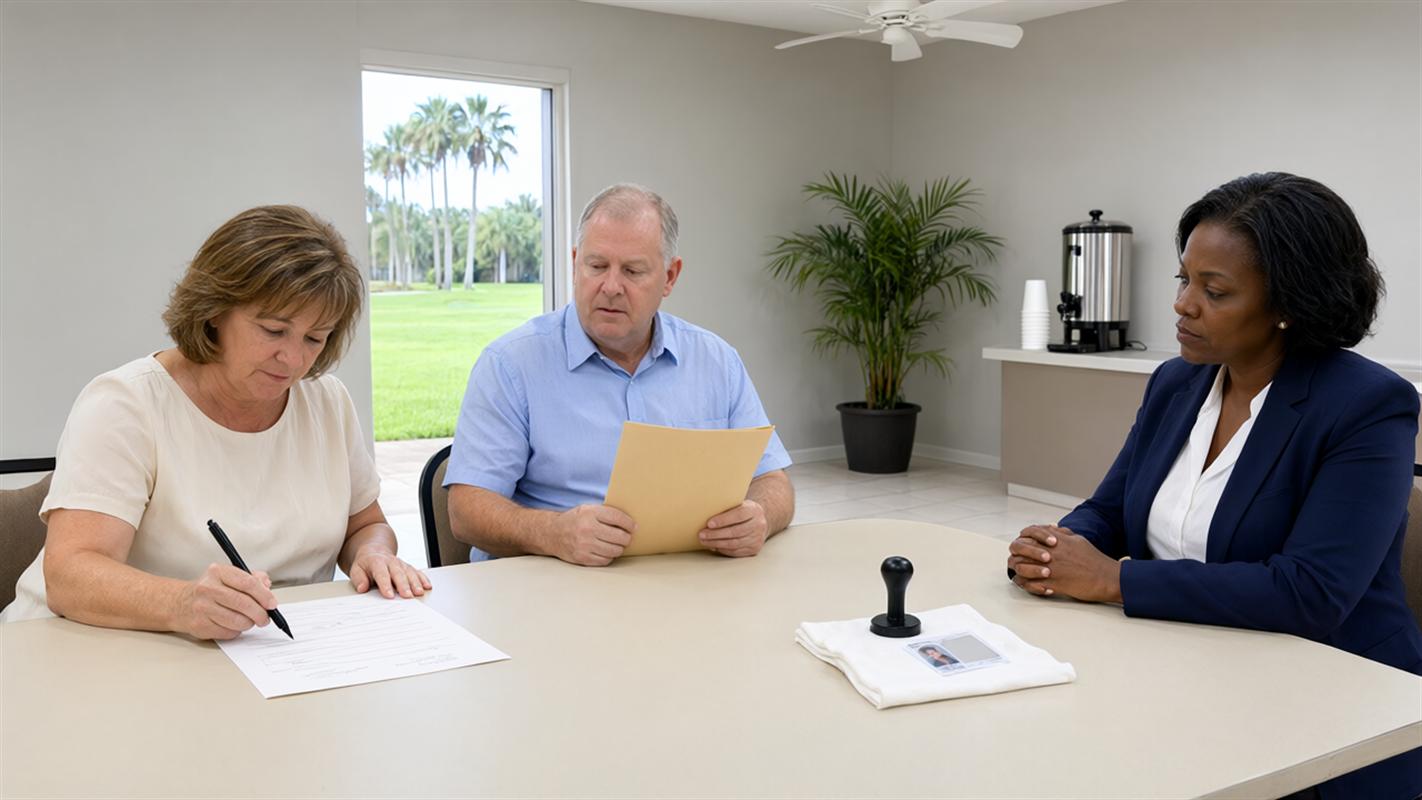
Four addresses can end up inside a single signing. There is the address on the signer’s identification, which is where the person lives. There is the address where the appointment actually happens, which might be a relative’s kitchen, a title office, a hospital room, or a bank lobby. There is the address the document describes, which for a deed or a mortgage is the property itself. And there is the address of the office that will read the finished packet, whether that is a clerk, a lender, or an attorney holding a file.
Those four can land in four counties, and the split is ordinary rather than exotic. A Florida notary commission is issued by the state rather than by a county, so a notary commissioned in Fort Myers is not confined to Lee County; travel is a scheduling question, not an authority question. What the county lines do change is the order of the work, because the appointment is planned around one address while the recording step follows another.
Mobile Notary Multiple Counties Florida: The Routing Question Behind the Phrase
Availability follows the exact street address, the requested appointment window, and the conditions on the road that day. It does not follow a county name or a city name. Two addresses inside one county can sit an hour apart when one of them is on a barrier island, and two addresses in neighboring counties can be twenty minutes apart when the route runs straight down one corridor.
Sunshine Mobile Notary, LLC works across communities that include Fort Myers, Cape Coral, North Fort Myers, Lehigh Acres, Estero, Bonita Springs, Naples, North Naples, Marco Island, Immokalee, Ave Maria, Port Charlotte, Punta Gorda, and Rotonda West. Those communities sit within a workable drive of Fort Myers for an appointment window, and the reasoning is laid out in the guide to how service areas are set by address, which puts the street address rather than the city name at the center of the schedule.
Which County the Recording Office Expects
Recording is a separate step from notarization, and it answers to a different address. The office that will receive the document sets the requirement, and for deeds and other property records that office is generally in the county where the property sits, because that is where the land records for that parcel are kept. The county on the envelope or in the signer’s mailing address does not decide it.
The notarial certificate is where the two locations meet. Under Florida Statute 117.05(4), the certificate states the venue, the type of act, whether the signer appeared in person or by audio-video online notarization, the date, the signer’s name, the identification type relied on, the notary’s signature and printed name, and the seal. The venue line records where the act took place, so a signing performed in Cape Coral for property in Collier County produces a certificate whose venue reads Lee County while the recording itself goes to Collier. That is not a conflict. It is two different questions being answered in two different fields.
The checklist for what to confirm before a Lee, Collier, or Charlotte County submission covers the details each clerk tends to look at, from the certificate fields to the version of the paper being sent.
When the Signer Is Not in the Property’s County
A signer who lives two counties from the property is normal, not a complication. The appointment can run as a mobile visit to the signer’s location or as a remote online session, and the deciding factor is the document and what the receiving office will accept, not the distance between the two addresses. Some packets are handled entirely online. Others are asked for with an in-person appearance.
A remote session leaves a record of its own. Under Florida Statute 117.245, the remote online notarization provider retains the session recording and the notary keeps a journal entry for each act, both retained for at least 10 years. That record documents what happened in the session, which is a different question from whether the office on the other end will take an electronically notarized page. Ask that second question before the appointment, not after.
For a closer look at the session itself, the explainer on how remote online notarization works in Florida steps through identity verification, the signing, and the record that follows.
Setting Up One Appointment That Spans Two Counties
A multi-county appointment gets easier when the details are settled before the notary is on the road. The list below is what keeps a two-county signing from turning into a second visit.
- Who signs, and where each signer will physically be when the appointment starts.
- Identification for every signer, since Florida Statute 117.05(5) allows personal knowledge or satisfactory evidence, lists the accepted identification types, and provides a two-witness alternative when identification is not available.
- Documents complete and unsigned, with the notarial signature lines left blank until the appointment.
- Witnesses, when the document or the receiving office calls for them, confirmed by name and availability.
- Access to the location plus a realistic travel window, including gate codes, facility check-in, and the hours the building will admit a visitor.
Cost is worth a word here as well, because it is often misread. Florida places a $10 ceiling on the charge for any one notarial act under Florida Statute 117.05(2)(a), and that ceiling is applied per act rather than per visit, so a packet with several signers or several documents can involve more than one act. What happens once the ink is dry is covered in the post-signing workflow for originals, which keeps the delivery question separate from the recording question.
What Sends a Multi-County Packet Back
Returns tend to trace to one of three mismatches. The packet names the wrong office for recording. The certificate records a place the office did not expect to see. Or the version that arrives is not the version that was signed, because a copy went out where an original was requested or a page was replaced after the appointment.
A fourth shows up with split sets, where the originals travel in different directions and nobody ends up holding the full packet. The reason a packet comes back is often the one thing the phrase “mobile notary multiple counties Florida” leaves out: which office is reading it. That single question decides which county line matters and where the paper has to land.
Where Local Support Fits
Sunshine Mobile Notary, LLC is owned by Valerie Nation and works out of Fort Myers. The service menu reads like a set of answers to the routing problem above: mobile appointments at a home, office, hospital, assisted living facility, or title office, remote online notarization on two platforms, loan signing agent support, county clerk recording support, and delivery of signed originals.
Each option answers a different kind of gap. A mobile visit covers the signer who cannot travel. A loan signing appointment covers a closing packet that a title or escrow team needs handled in one sitting. Recording support covers the submission that needs a second reader before it goes out. Delivery covers the original that has to reach another county without changing hands twice.
For the in-person side, the page on mobile notary appointments in Fort Myers sets out what an appointment involves. For closing work, the overview of loan signing agent support for title and escrow teams describes how a full packet is handled.
Questions That Come Up When a Signing Crosses County Lines
Does the notary have to be commissioned in the county where the signing happens?
A Florida commission is issued by the state, so a notary may perform a notarial act in any Florida county. What varies is the drive and the appointment window, which is why the address matters more than the county name.
Which location goes on the certificate if the signer and the property are in different counties?
The certificate records the venue where the notarial act took place, along with the other fields listed in Florida Statute 117.05(4). The recording office is a separate decision, generally set by where the property sits and by the instructions of the office receiving the document.
Can a remote session replace a mobile visit for a signer in another county?
Sometimes, and the receiving office decides. Some documents travel well as an electronically notarized page, while others are requested with an in-person appearance. Confirm that before the appointment is booked, especially when a deadline is attached.
Key Takeaways
A multi-county signing stays manageable when the addresses are sorted before the appointment rather than after it.
- The signer’s address, the signing location, the property, and the receiving office can each sit in a different county.
- A Florida notary commission is statewide, so county lines affect travel and scheduling rather than authority.
- The certificate venue records where the act happened; the recording office is generally set by the property and by the receiving office’s instructions.
- A short question to the office receiving the packet catches a mismatch while it is still easy to fix.
Conclusion
Sunshine Mobile Notary, LLC handles the routing side of these signings, from homes and offices to hospitals, assisted living facilities, and title offices across Lee, Collier, and Charlotte counties. Appointments run from 8 AM to 8 PM Monday through Saturday and 1 PM to 5 PM on Sunday, and the phone line is 239-691-0885 for anyone who wants to talk through a packet before booking.
If a signing is spread across two counties and the sequence is still unclear, ask the question first. A short conversation about who signs where, which office receives the paper, and when the deadline lands usually settles the plan before the appointment is on the calendar.