For someone handling estate documents, real estate paperwork, affidavits, or time-sensitive forms, the question is reasonable: how can a notary verify identity and help protect an important document without meeting in person? Sunshine Mobile Notary, LLC helps clients determine whether remote online notarization or mobile, in-person service better fits the document, the signer’s circumstances, and the receiving organization’s requirements.
The Short Answer: Online Notarization Can Be Secure When the Right Safeguards Are Used
A properly conducted remote online notarization uses several layers of verification. The signer’s identity is reviewed, the notary meets with the signer through live audio-video technology, the notarial act is completed electronically, and records are created to document the session.
- Identity proofing helps confirm who is signing.
- Live audio-video communication allows the notary to interact with the signer in real time.
- Electronic notarial certificates and seals connect the notarial act to the completed document.
- Audit information, journal records, and recordings can help document what occurred during the appointment.
Security and acceptance are separate issues. A RON session can follow a secure process, while a lender, title company, court, government office, or other recipient may still require an in-person notarization or original paper documents. Confirming that requirement before signing can help avoid delays and a repeat appointment.
Remote Online Notarization Is More Than a Video Call
Remote online notarization, often called RON, is a notarial process completed through audio-video technology in accordance with applicable requirements. It is not the same as emailing a signed PDF, clicking an e-signature box, or showing identification during an informal video call.
A common misunderstanding is assuming that a digital signature alone makes a document notarized. It does not. A notarization requires a commissioned notary to complete the notarial act and apply the appropriate electronic notarial elements after the required verification steps are completed.
For a full process overview, see how remote online notarization works in Florida.
What Makes a Notarization “Remote Online”
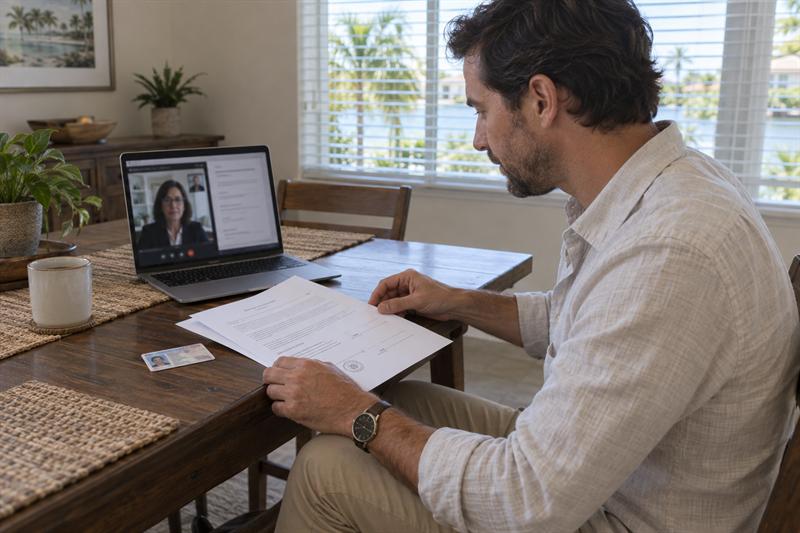
In a remote online notarization, the signer appears before the notary through live audio-video communication instead of meeting in person. The notary still has an active role: reviewing identification, communicating with the signer, confirming the signer appears willing to proceed, and completing the notarial certificate.
The process must be structured, not improvised. A platform without a live notary session and a clear identity-verification workflow may not include the elements required for a complete RON appointment.
Why an Ordinary E-Signature Is Not the Same as RON
An electronic signature shows that someone signed a document electronically. It does not automatically show that a commissioned notary verified the signer’s identity or performed a notarial act.
- E-signature: A person signs electronically.
- Video call: Two people communicate remotely.
- Remote online notarization: The signer completes identity-verification steps, appears live before a commissioned notary, and receives an electronically notarized document with associated records.
This distinction matters when a document is being submitted to a title company, financial institution, attorney, or government office. Sending a signed document when a notarized document is required can result in rejection, corrections, and another appointment.
How an Online Notary Verifies Your Identity
Online identity verification is designed as a layered process, not a single ID upload. Exact steps depend on the platform and applicable requirements, but the purpose remains the same: to establish that the person appearing before the notary is the person named in the document.
Identification issues can prevent an appointment from moving forward. A signer who waits until the session to locate ID, or presents an expired, unreadable, or damaged credential, may be unable to complete the notarization until the issue is resolved.
Government-Issued Identification and Credential Analysis
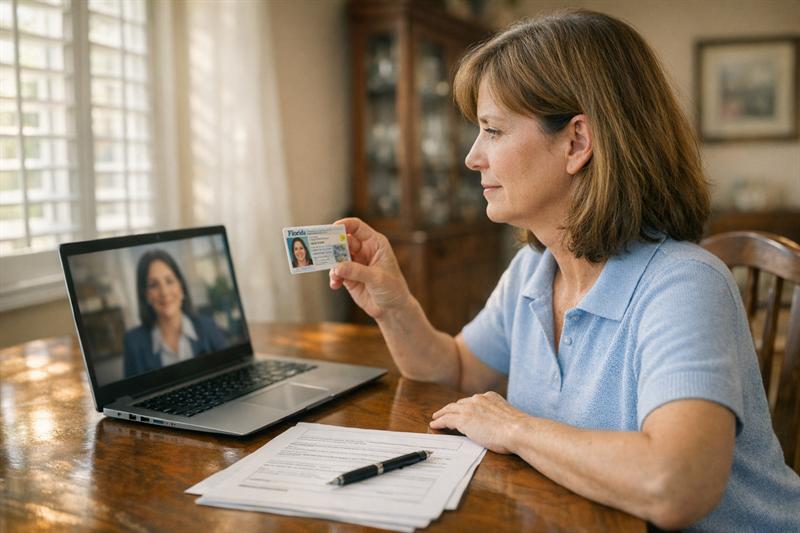
A signer is generally asked to provide a government-issued identification document that meets the process requirements. The RON process may also use credential analysis, which is a technology-assisted review of an ID’s characteristics to help identify inconsistencies or signs that the credential may not be reliable.
Credential analysis is more than a photo comparison. It is one part of a broader identity review before the notary proceeds with the notarization.
Before any appointment, review the acceptable forms of ID for a Florida notary. Having the correct identification ready can prevent an avoidable delay.
Identity-Proofing Questions or Authentication Steps
Some remote notarization processes include knowledge-based authentication or other identity-proofing steps. These steps add a layer beyond presenting an ID by requiring the signer to complete verification prompts connected to identity information.
If the signer cannot complete a required authentication step, the session may need to pause until the identity concern is resolved. That safeguard is intended to help protect the signer, the notary, and the organization receiving the document.
Live Audio-Video Interaction With the Notary
During a RON session, the notary communicates with the signer in real time. This interaction allows the notary to communicate directly with the signer and observe whether the signer appears willing to proceed.
The process may need to stop if someone attempts to sign for a person who is not present, cannot participate in the session, or appears to be pressured by another person. A notary may pause or decline the session when identity, willingness, or communication cannot be established.
What Protects the Document After It Is Notarized?
Once a document is notarized online, the completed file generally includes electronic notarial elements and transaction information connected to the session. These safeguards are designed to help show whether a document has been changed after notarization and to preserve a record of the transaction.
The point is not that a document can never be altered. A properly structured electronic notarization creates indicators and records that can help identify or document later changes. That provides more protection than circulating an unsigned or unverified PDF by email.
Electronic Notarial Certificates, Seals, and Signatures
An electronically notarized document generally includes a notarial certificate that reflects the act performed by the notary. It may also include an electronic seal and signature associated with the completed notarization.
These elements are not the same as typing a name at the bottom of a document. They connect the notarial act to the document completed during the remote session.
Tamper-Evident Technology and Document Integrity
Tamper-evident technology is designed to reveal whether changes were made to a completed electronic document. If a document recipient reviews the file, these controls can help show whether the notarized version remains intact.
This becomes important when documents move through several hands. A signer who saves, edits, or re-exports a document after notarization may create a version that no longer matches the completed file. Preserve the notarized document as delivered and submit that version unless the recipient provides different instructions.
Audit Trails, Electronic Journals, and Recorded Sessions
A remote online notarization can create records associated with the appointment. These records may include transaction details, electronic journal information, an audit trail, and an audio-video recording of the session.
- Audit trail: A record of activity connected to the transaction.
- Electronic journal: A record of the notarial act and related details.
- Audio-video recording: A record of the live remote session.
These records can be important if the notarization is later questioned or reviewed. Without a documented process, it may be harder to establish what happened, who participated, and how identity was evaluated.
Is Online Notarization Safe for Sensitive Documents?
Online notarization can be appropriate for sensitive documents when the signer uses a legitimate RON process, protects personal information, and confirms the receiving organization’s requirements. Sensitive documents require care, not shortcuts.
Estate documents, financial forms, real estate paperwork, and affidavits can contain personal information that should not be uploaded through unknown links or sent through unsecured channels. Use the official appointment process, protect access to the completed document, and verify acceptance before the signing takes place.
Privacy Considerations Before Uploading Documents
Signers should use a private setting, a secure device, and a reliable internet connection during a remote appointment. Public Wi-Fi, shared devices, and forwarded appointment links can create unnecessary exposure for sensitive documents.
- Use the official appointment link provided by the notary service.
- Keep identification and documents out of view of people who are not part of the appointment.
- Avoid public Wi-Fi when handling personal or financial paperwork.
- Save confirmation details and the completed notarized document in a secure location.
If an appointment link, document request, or communication seems inconsistent, pause before uploading information. Verifying the request first can help prevent an avoidable privacy issue.
Why the Receiving Organization’s Requirements Still Matter
A secure RON appointment does not guarantee that every organization will accept the document. Acceptance depends on the recipient’s policies, the document type, and the requirements connected to the transaction.
Before scheduling, ask the lender, title company, attorney, court, government office, employer, or other recipient whether remote online notarization is accepted. If the answer is unclear, request confirmation in writing. Waiting until after the document is notarized can result in a repeat appointment and missed deadlines.
When a Mobile, In-Person Notary May Be the Better Choice
Remote online notarization is practical when the signer has the required technology, suitable identification, a private location, and a recipient that accepts RON. A mobile, in-person appointment can be the better choice when one of those conditions is not in place.
Sunshine Mobile Notary, LLC offers both options because the right notarization method depends on the situation. The goal is not to force every document into an online process. It is to use the format that helps avoid rejection, delays, and unnecessary repeat work.
- Choose RON when: the recipient accepts remote notarization, the signer can complete digital verification, and a live remote appointment fits the timeline.
- Choose a mobile notary when: the recipient requires wet-ink or in-person notarization, the signer has technology barriers, reliable internet is unavailable, or physical original documents are required.
For a closer comparison, read Mobile Notary vs Online Notary: Which Option Is Right for You?.
Checklist: How to Choose a Secure Online Notary Service
If a rejected notarization could delay a closing, filing, or personal deadline, verify the process before you book.
- The notary should be properly commissioned and authorized to perform remote online notarization where required.
- The appointment should include a clear identity-verification process, not just an uploaded signature.
- The notary should meet with the signer through live audio-video communication.
- The process should create transaction records, such as audit information or electronic journal details.
- The signer should use a private setting, secure device, and official appointment link.
- The receiving organization should confirm that it accepts RON for the specific document.
If any of these points are unclear, resolve the issue before signing. Skipping these checks can result in a rejected document and a second notarization appointment.
Key Takeaways
- Online notarization is not just a video call or electronic signature.
- A secure RON process uses identity proofing, live interaction with the notary, electronic notarial elements, and transaction records.
- Document-integrity tools are designed to help identify or document changes after notarization.
- Recipient acceptance should be confirmed before scheduling, especially for real estate, financial, government-related, and other important documents.
- A mobile, in-person notary appointment can be a useful option when technology, document requirements, or signer circumstances make RON unsuitable.
Conclusion: Choose the Notarization Method That Fits the Document and Situation
The real risk is not simply using an online notary. The risk is using the wrong process, skipping identity and acceptance checks, or assuming an electronic signature is the same as a completed notarization. Those mistakes can lead to rejected paperwork, repeated appointments, and delays when the document matters most.
Sunshine Mobile Notary, LLC provides remote online notarization and mobile, in-person service so clients can choose the format that fits their document requirements and circumstances. If the recipient accepts RON and the signer can complete the verification process, an online appointment can be a practical solution. If an in-person notarization is required or the remote process creates barriers, mobile service provides a direct path forward.
For help selecting the right appointment type, visit Sunshine Mobile Notary, LLC for mobile and remote online notary services in Southwest Florida.
Frequently Asked Questions
Is online notarization as secure as meeting a notary in person?
Online notarization can be secure when it uses identity verification, live audio-video interaction with the notary, electronic notarial records, and document-integrity controls. The important question is whether the required verification and documentation steps are completed, not simply whether the notary is physically present.
For example, a basic e-signature does not create the same identity and transaction record as a RON appointment. Before scheduling, confirm that the receiving organization accepts remote online notarization for the document.
How does an online notary verify my identity?
An online notary may verify identity through government-issued ID review, credential analysis, applicable authentication steps, and live audio-video interaction. These checks work together to establish that the person appearing before the notary is the signer named in the document.
Have suitable identification ready before the appointment. If the ID is expired, unreadable, or unavailable, the session may not move forward until the identification issue is corrected.
Can an online notarized document be changed after the appointment?
Electronic notarization platforms can use tamper-evident controls designed to show whether a completed document has been modified after notarization. The completed document also generally includes electronic notarial elements connected to the transaction.
A common mistake is editing or re-saving the completed document before sending it to the recipient. Keep the notarized file in its delivered form and submit that version unless the recipient gives different instructions.
Are online notarized documents accepted by banks, courts, and title companies?
Acceptance depends on the receiving organization, the document type, and the requirements of the transaction. A secure RON process does not automatically mean every lender, court, title company, or government office will accept the document.
Confirm acceptance before scheduling. This step can prevent discovering after the appointment that an in-person or wet-ink notarization was required.
What records are created during a remote online notarization?
A RON transaction may create electronic journal information, transaction details, an audit trail, and an audio-video recording of the session. These records help document what happened during the notarization.
If a document is later reviewed, those records can help establish the session details and verification process. Ask the notary service how completed documents are delivered and what transaction records are associated with the appointment.
When should I choose a mobile notary instead of online notarization?
Choose a mobile notary when the document recipient requires in-person or wet-ink notarization, when the signer cannot complete online identity verification, or when reliable internet and a private setting are not available. An in-person appointment is also a clear choice when original paper documents must be handled directly.
Confirm the recipient’s requirements first, then select the option that helps avoid a rejected document. Sunshine Mobile Notary, LLC can provide either remote online notarization or mobile service based on the needs of the appointment.