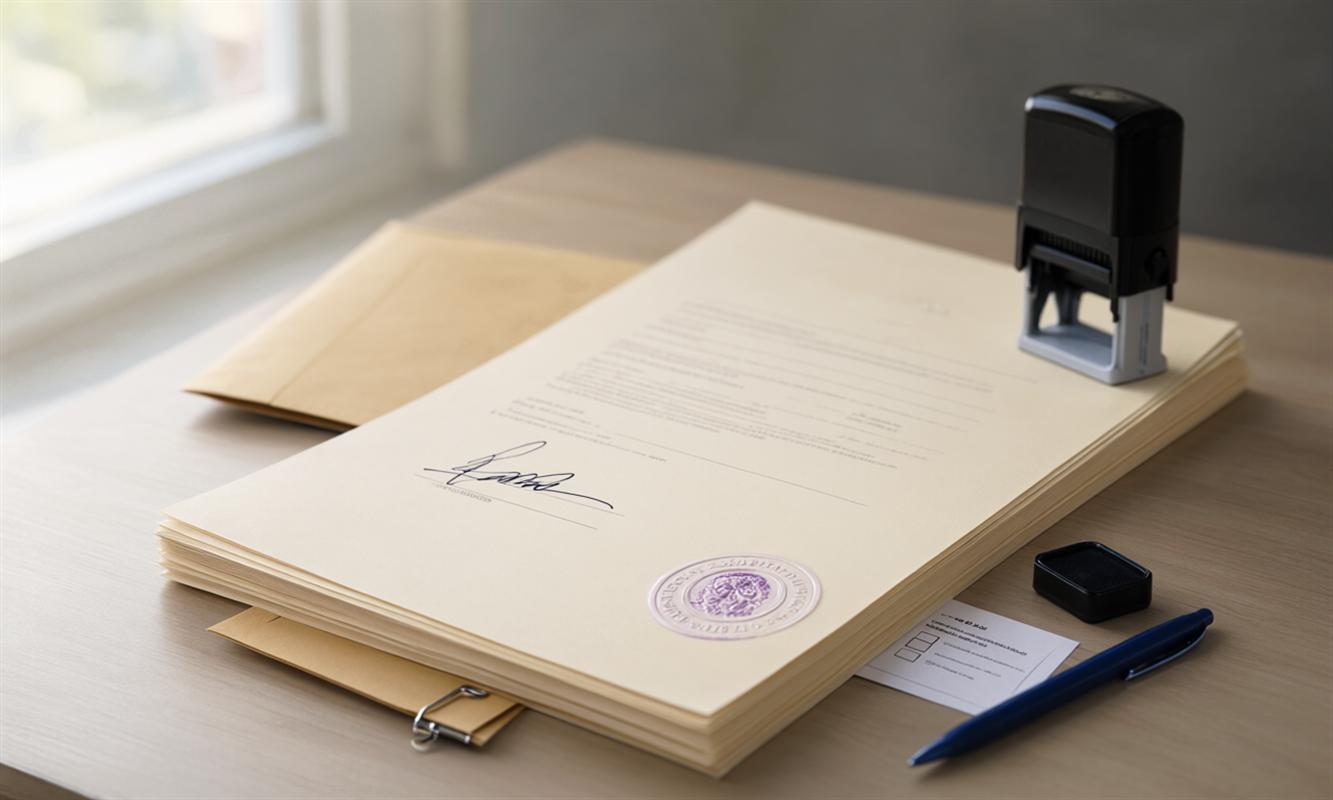
Quick Answer: Searches for “business document notarization Florida” usually begin with a packet that already has a deadline attached. The work then follows a sequence: confirm who inside the company may sign, gather every document into one packet and leave the signature lines blank, decide whether the recipient needs wet ink or accepts an electronically notarized copy, and only then book the appointment. A notary verifies identity and willingness to sign; the company supplies the authority, the complete paperwork, and the record afterward.
Key Takeaways
- Business signings go wrong at the front end, not at the seal: an unsigned packet, a mismatched title, or a missing witness causes more repeat visits than identification problems.
- A notary confirms identity and a willing signature. Authority to sign for a company comes from the document and the entity’s own records, not from the notary.
- One execution packet, handled by one point of contact, usually costs less time than several separate appointments.
- Employment forms and I-9 document review are separate processes, and an I-9 is not notarized.
- Ask the receiving office about format and copies before the appointment, because a mobile visit and a remote session produce different documents.
Why a Business Signing Runs on a Different Clock Than a Personal One
A personal notarization is often one signer, one document and one short appointment. A company signing rarely looks like that. There may be a contract and an amendment, a written authorization for the person signing, a bid packet that needs a sworn statement, and onboarding forms waiting on the same visit. Each document has its own certificate page and signing order, and sometimes its own witness requirement.
The receiving side changes the stakes too. An internal file, a lender, a county office, or a partner company reads the notarial certificate first, and a signature page that does not match what that office asked for is a delay nobody notices until the packet is gone. Handling matters as much as the signature: Sunshine Mobile Notary, LLC states that documents are kept in a secure, access-controlled setting, that records are audited on a regular schedule, that electronic documents are encrypted, that the notary has completed a background check, and that a bond is in place.
Who Is Actually Authorized to Sign for the Company
Before anything gets notarized, settle who is signing and in what capacity. A contract may name the entity, a title, or a specific individual; a corporate resolution or written authorization may name the person the company has designated to act. That paperwork belongs in the packet. The notary cannot decide who holds authority inside a business, and the certificate records the person who appeared, not the person entitled to appear.
What the notary does verify is identity and willingness. Florida allows identification by personal knowledge or by satisfactory evidence, meaning an acceptable form of photo identification, and provides a two-witness alternative when identification is not available. That is the check the certificate records, which is why the signer, not a stand-in, has to be at the appointment. A colleague sent in someone’s place does not solve that problem; it moves it.
Two habits save a second visit: compare the printed name and title beside the signature line against the identification the signer will present, and check the notary’s commission through the state’s own lookup when someone new is arranging the appointment. A middle initial or a former name that no longer matches the card becomes a question at the table.
Which Business Documents Typically Carry a Notarial Certificate
Much of the business document notarization Florida offices request falls into a few familiar families. Contracts and amendments are the obvious ones, particularly when a lender, landlord, or vendor wants signatures witnessed. Written authorizations and corporate resolutions follow, since they are the paper that lets a named person act for the entity. Sworn statements and affidavits appear when a company must attest to something for a bid, a claim, or a filing.
Property and finance paperwork makes up the next group: deeds, mortgage and loan packets, and documents headed for county recording. Employment forms sit in their own category, because the requirements come from the employer or a government office rather than from the notary.
If a document arrives without instructions, the useful question is not whether it looks official but what the receiving office will accept. If you are sorting out which category applies, the guide to which documents need notarization in Florida walks through these families and the reasons behind them.
Building One Execution Packet Instead of Six Appointments
A company with six documents and three signers can spend a week chasing appointments, or it can assemble one packet and finish in a single sitting. The packet approach works because the notary’s time on each document is short; the cost sits in travel and setup.
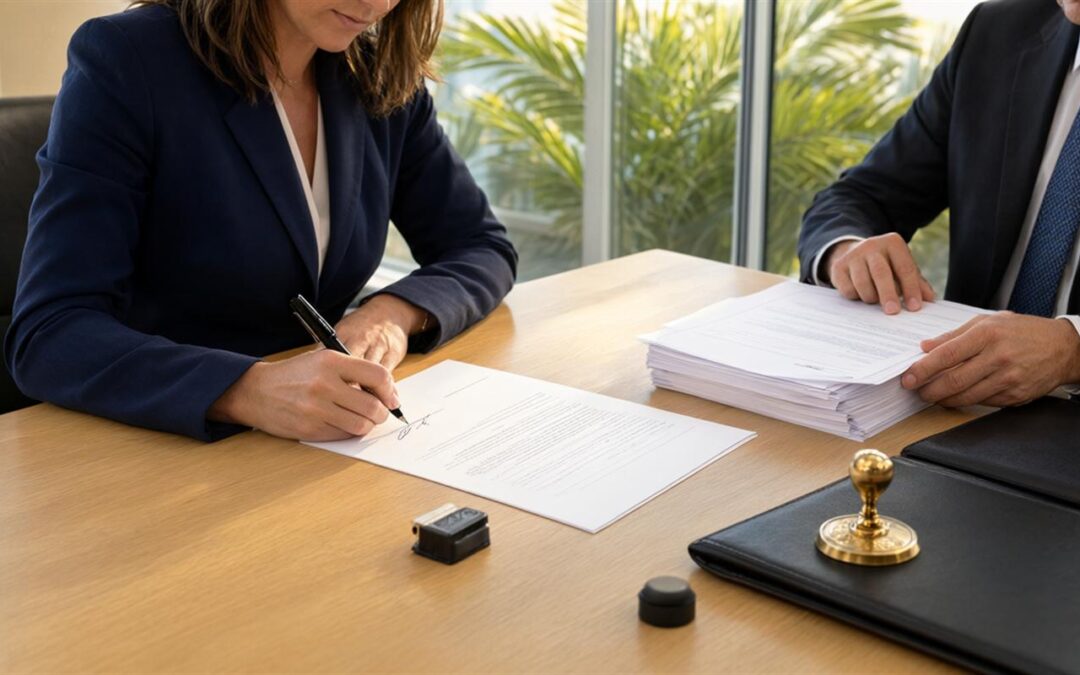
Start by naming one point of contact. That person gathers the finalized documents, confirms that every signature line is still blank, sets the signing order, and decides whether witnesses will be present. Documents should arrive complete and unsigned, with attachments in order, because a packet still being printed at the appointment is a packet that will not finish. If a document needs witnesses, they are part of the plan, not an afterthought.
Signing order is worth writing down. When an authorization has to be executed before the contract it supports, or a resolution before the agreement it enables, sequence is part of the document’s logic. The article on coordinating several signers in one notary appointment covers the group mechanics, including what to do when one signer cannot attend.
Employee Forms: Where Notarization Fits in Onboarding
Onboarding paperwork is where business signing and employment rules overlap, and where a common misunderstanding costs time. Form I-9 is not notarized. It is completed by the employer and the employee, and when an employer uses a designated representative, that person reviews the employee’s identity and work-authorization documents in person on the employer’s behalf. No seal is involved.
Other employment documents may carry a notarial certificate depending on who is asking: a sworn statement attached to a background or licensing process, an authorization a bank requires before adding a signer to an account, or a company document naming an officer. Those are notarized in the ordinary way, and the employer still owns the compliance question behind them. The employer remains responsible for the I-9 itself even when a representative conducts the review.
Employers sorting out the difference can read what employers and employees should expect from I-9 verification, which separates the two processes step by step. A remote hire who needs an I-9 review and a new officer who needs a notarized authorization are two appointments with two different purposes.
Mobile Visit or Remote Session: Matching the Format to the Document
Format is not a preference; it follows from what the recipient will accept. Some offices want an original with a wet-ink signature and a seal. Others accept an electronically notarized document produced in a video session, where the signer appears by audio-video and the certificate says so. Getting this backwards turns a completed signing into a rejected one.
Ask the receiving office two questions before booking: whether an electronically notarized copy is acceptable, and whether the file must arrive as an original, a copy, or both. That answer also explains why not every business document notarization Florida accepts can be completed online: the document and the receiving office set the terms, and a notary cannot change them.
Where an in-person signature is needed, a mobile appointment brings the notary to the office, the conference room, or a title office, so the packet can be executed without moving a group across town. A remote session suits a signer out of the area or a company with staff in several places. Both formats are available here: mobile notary appointments for Fort Myers businesses cover the in-person route, and remote online notarization sessions cover the video route.
What the Receiving Office Checks Before It Accepts the Packet
A Florida notarial certificate has a fixed set of parts: the venue, the type of notarial act, whether the signer appeared in person or by audio-video online notarization, the date, the signer’s name, the type of identification relied on, the notary’s signature and printed name, and the seal. An office reads those fields against its own instructions. A mismatched act type or a blank identification line returns the document even when the signature is genuine.
Name matching is the next stop: the name on the certificate, the name beside the signature, and the name on the identification have to line up for the reviewer. Witness lines, if the document calls for them, need signatures and printed names that match the people who were actually present. The version of the document matters as well, since an outdated revision and a current one produce two different packets.
A notary cannot choose the certificate for you, cannot explain what a document means, and cannot say in advance whether an office will accept the result. What a notary can do is complete the certificate accurately and record what happened at the appointment. Documents headed for the public record usually take one more step through the county clerk’s office, and recording support is among the services listed here.
Frequently Asked Questions
Who keeps the signed original after a business signing?
Plan on leaving the appointment with the original in hand. The notary does not hold client originals afterward, so the company’s file, the lender, or the office that requested the document is where the paper belongs. Making working copies before the appointment is easier than trying to reproduce a signed page later.
Can a notary travel to more than one office in a day?
That depends on the addresses, the times, and what else is on the schedule, so it is a routing question rather than a rule. Give the notary every location and the order you would prefer when booking, and ask for the travel piece in writing; three offices spread across three cities take more of a day than three floors of one building.
What changes when a notarized business document is going overseas?
The notarization is completed the same way, and then a separate step may apply. An apostille is issued by the Florida Department of State’s Division of Corporations, requires the original notarized document rather than a photocopy, and runs on its own timeline. The country of use matters, because it decides between an apostille and a certification route, so confirm the destination’s requirement before the appointment.
Conclusion: Sequence the Signing, Then Keep the Record
Business signing gets simpler once it is treated as a sequence rather than a single errand: settle authority, assemble and leave the packet unsigned, confirm the format with the receiving office, execute in order, and file the result where the company can find it again. The notary’s part in that sequence is the identity check and the certificate. Everything else belongs to the business.
Sunshine Mobile Notary, LLC is owned by Valerie Nation and works from Fort Myers, traveling to homes, offices, hospitals, assisted living facilities and title offices, with remote online notarization available on two platforms. Appointments can be arranged by phone at 239-691-0885 or by email at [email protected], and the office is at 13300 S. Cleveland Avenue, Fort Myers, FL 33907. The service area includes Fort Myers, Cape Coral, North Fort Myers, Lehigh Acres, Bonita Springs, Estero, Naples, Marco Island, Port Charlotte and Punta Gorda. If a packet is already on the calendar, a short call to confirm the signers, the format and the return path is a reasonable place to start.