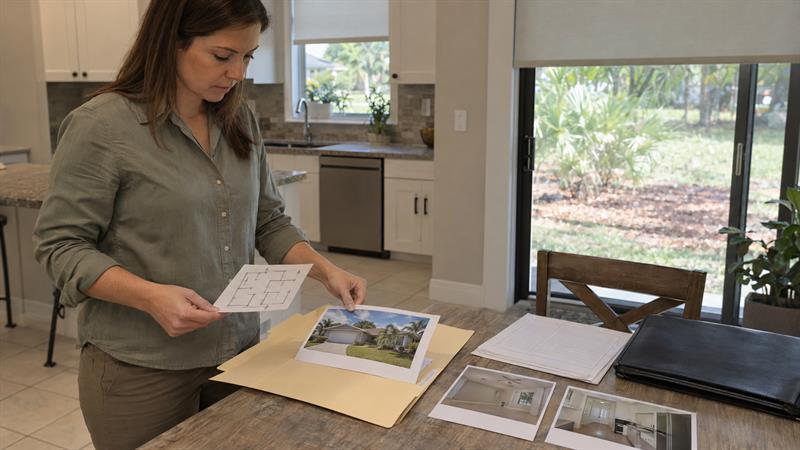
Most requests for real estate photo documentation Southwest Florida owners bring to a closing file arrive with a date already attached. A title team needs the set before documents go out. A lender asks for condition photos before a draw is released. An insurer wants to see a room as it looked on a particular day. The photographs themselves are the simple part. The difficulty comes later, when a picture with no address, no date, and no label describing the view turns into a mystery the moment the appointment ends. What follows is a plain look at what a property file expects from a photo set, what to confirm before anyone starts taking pictures, and where the record fits once a closing or a claim is under way.
Quick Answer: The office receiving the file sets the standard, so the work starts with one short conversation: what to photograph, how to name it, what format to send, and who receives it. A set built from that answer, with the address, date, view, and order left intact, is the one that still reads clearly months later. Everything else about the practice follows from that exchange.
Key Takeaways:
- A photo set earns its place in a file when the address, date, and view are labeled on it.
- File names and storage decide whether the recipient can still find the set months later.
- Each office keeps its own list, and the list is confirmed with that office before capture.
- Photo documentation records what was visible; it does not set value or replace an inspection.
- Confidentiality questions are settled by naming the recipients before any file leaves the table.
What Real Estate Photo Documentation Means in a Property File
Photo documentation is a dated record of what was visible at a property on a particular day, filed with the rest of that property’s paperwork. The difference between that and a folder of pictures on a phone is not the camera. It is the intent. A record is assembled for someone who was not there and will look at it later, often long after everyone involved has moved on to another transaction.
In practice, such a set sits beside things like a deed or settlement file, an insurance claim file, a lender’s property condition review, a property manager’s turnover file, or an ordinary post-closing question about how a room looked on a date. Each of those holders cares about a slightly different detail, which is why a generic batch of images so often disappoints one of them. The set that works is the one built to answer a specific reader’s question.
The Details That Make a Photo Set Readable Later
A usable set carries five things: the street address and unit, the date and time of capture, the name of the person who took the images, a room name or a direction for each view, and a sequence that can be followed from start to finish. Those details can live in a file name, an index sheet, or a label on the image itself. What they cannot do is live only in someone’s memory of the visit.
An index helps more than most people expect. One page, or one opening image, that names the property, the date, the person who took the set, and how many images follow gives the next reader a map before the detail arrives. A set without one can still be usable, but the reader has to reconstruct the shape of the visit from the file names alone.
The real test is whether the real estate photo documentation Southwest Florida property files can carry still makes sense to a reader who was not present. A set that opens on the exterior, moves through the rooms in a consistent direction, and labels each view passes that test. One that begins in a hallway and jumps between bedrooms does not, even when every frame is sharp and evenly lit. Missing labels cause more rejected sets than poor exposure does.
What to Confirm Before the Photos Are Taken
Expectations belong to the office that will hold the file, and the time to ask is before the first image is captured. A short confirmation call or email covers most of what a closing, claim, or turnover file will scrutinize later.
- The address and unit exactly as the receiving office writes them.
- The date window the office will accept, and whether the capture date must fall before or after a milestone.
- Which rooms and views are required, and whether the exterior, closets, or mechanical spaces are included.
- The file format and naming pattern the office prefers, in the words that office uses.
- Who receives the files, by what route, and whether a courier or a secure upload is expected.
- Whether the set joins an existing property file or starts a new one.
Retention and formatting expectations belong to that receiving party, not to the person holding the camera, so the answers are worth writing down. A property owner, a title team, and an insurer can each ask for a different set from the same house on the same afternoon.
Where Photo Documentation Fits the Closing and Recording Chain
In Florida, an instrument tied to real property is recorded with the clerk of the county where the property sits. The county follows the property address, not the signer’s home address, which is one reason a photo set that shows the address clearly earns its place in the packet. Where files stall is usually not the signing itself but a supporting item that arrived unlabeled or in a format the receiving desk could not open.
The signing appointment follows instructions from the lender and the title company, and what happens at a Florida closing signing is largely a matter of executing those instructions in order. Recording is a separate step from signing, and county clerk recording preparation is where the county choice, the formatting, and the accompanying records get settled. After the appointment, the post-signing document workflow is what decides how originals, copies, and supporting records reach the offices that asked for them.
A file that carries real estate photo documentation Southwest Florida closing teams can actually open moves through review with fewer questions than one that does not. That is the whole case for the set: fewer return calls, fewer re-shoots, and a record that answers the obvious question before it is asked.
Photo Documentation, an Appraisal, an Inspection, and a Listing Shoot
An appraisal and an inspection each produce an opinion or a finding from a qualified professional. An appraisal addresses value, and an inspection reports on condition in detail. Photo documentation does neither. It records what a camera could see on a date, and it sits alongside those reports rather than standing in for them.
A listing shoot answers a different question again, since its job is to present the property to buyers. Those images are chosen and finished to look appealing, while documentation images are chosen to be identifiable. Neither kind replaces the other, and a marketing set is rarely arranged in a way that a claim file or a closing file can follow.
Confidentiality, Recipients, and Who Holds the File
Property photographs can show interiors, belongings, security features, and whether a home appears occupied. That makes the recipient list a privacy question as much as a paperwork one. Naming who receives the files, and settling how they travel, is worth doing before anything is shared rather than after.
Storage matters for the same reason. A name carrying the date, address, and view, saved in a format the recipient can open, in a location the recipient can reach while the file is still active, is the difference between a usable record and a dead link. Where a signing and the photo set happen in the same visit, a mobile notary service in Fort Myers can confirm the recipient list before the files leave the table.
What Photo Documentation Cannot Do
A photograph records what was visible. It does not establish condition beyond what the camera caught, does not set a value, and does not take the place of an inspection or an appraisal. A set that shows a clean kitchen on a Tuesday says nothing about the plumbing behind the wall or the roof above it.
It also does not decide whether a receiving office accepts a file. That call belongs to the office holding its own requirements, and the honest way to settle it is to ask that office directly. Read the photo set as one piece of evidence among several, and route questions about value, condition, and acceptance to the people qualified to answer them.
Conclusion: Confirming the Record Before the File Closes
Sunshine Mobile Notary, LLC handles real estate photos alongside notary work, loan signing, and document delivery across Fort Myers, Cape Coral, Estero, Bonita Springs, Naples, North Fort Myers, Lehigh Acres, Marco Island, Port Charlotte, and Punta Gorda. Appointment hours run from 8 AM to 8 PM Monday through Saturday, with 1 PM to 5 PM on Sunday. The practical value of a documented set shows up months later, when a question about a room, a date, or a repair arrives and someone can open the file and find an answer.
Where a closing is on the calendar, mobile loan signing agent support can cover the appointment and the accompanying paperwork in one visit. If the question is simply what a particular office will expect from a photo set, that is worth asking before the appointment rather than after. Call 239-691-0885 to book a time or to talk through what the file needs.