Before booking a notary appointment, confirm three things: who is receiving the document, what they require, and whether they will accept the way the document is being signed. At Sunshine Mobile Notary, LLC, this issue comes up because people are told to “get it notarized” without being told what the receiving party will actually accept.
Why You Should Confirm Acceptance Before Scheduling a Notary
A notarization can be valid and still fail to do the job it was meant to do. That happens when the receiving party has separate requirements for witnesses, certificate wording, original signatures, document format, or remote online notarization.
This comes up with real estate documents, court filings, powers of attorney, travel letters, and employer paperwork. The signing gets scheduled first, then someone realizes the wrong version of the document was used or the recipient will not accept the format. That can lead to delays, repeat signings, and extra coordination.
- Wrong notarial certificate wording may lead to rejection
- Missing witnesses can keep the document from being accepted for its intended purpose
- Recipient refusal of remote notarization may require a second appointment
- Original or wet-ink signature requirements can block submission
- County or agency filing standards can create problems after signing
If you want the appointment to solve the problem instead of creating another one, confirm acceptance first. Then schedule the right kind of signing with the right preparation. For a full scheduling checklist, see How to Schedule a Mobile Notary Appointment: Information to Have Ready.
Who Actually Decides Whether a Document Needs Notarization
The receiving party usually sets the acceptance standard. In some situations, the document preparer, title company, lender, attorney, court, employer, or agency may already define how the document must be signed and submitted.
The key distinction is simple: a notary performs the notarial act, but the notary does not decide whether another party will accept the document for filing, closing, processing, or other official use. That boundary matters. It is also why what a notary can and cannot do during an appointment should be clear before the document is signed.
The Receiving Party
If a title company, court clerk, county recorder, employer, agency, school, or foreign authority is reviewing or relying on the document, their rules matter most. They generally decide what they will accept, not the person forwarding the paperwork and not the notary completing the act.
A common pattern is that the signer asks the wrong person. A family member, assistant, or front-desk contact may say “just get it notarized,” but the actual reviewing office may expect something more specific. This is where problems often start.
The Document Preparer, Attorney, Lender, or Issuing Institution
Some documents come with built-in instructions. Loan packages, deed documents, agency forms, and attorney-prepared documents often specify how the signing must happen.
In those cases, the more useful question is not “What does a notary usually do?” It is “What does this document package require?” In title and closing matters, that issue is especially important because the document usually has to move through signing, return, and final review without breaking the process.
What the Notary Can and Cannot Determine
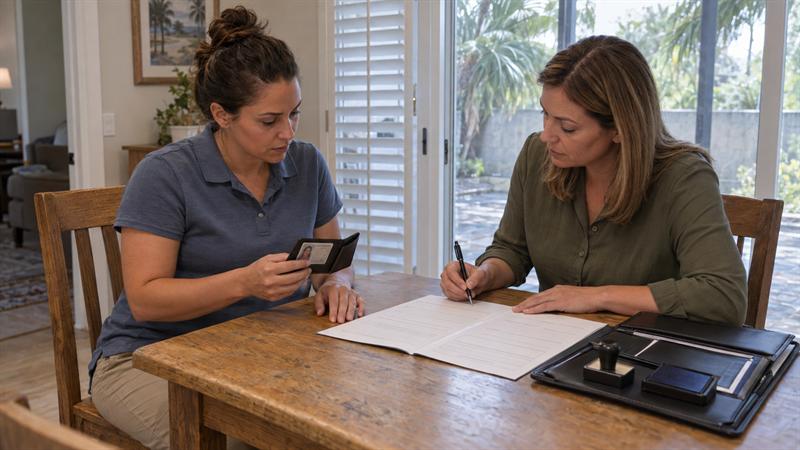
A notary can verify identity, witness a signature when required, and complete a lawful notarial act. A notary cannot choose requirements for a title company, court, county clerk, employer, or agency.
- A notary can complete the certificate tied to the act being requested
- A notary can check signer ID and document readiness
- A notary cannot decide what a receiving party will accept
- A notary cannot give legal advice about whether notarization is necessary for your purpose
This is often misunderstood when people treat the notary as the final authority on the document’s end use. The notary’s role is important, but acceptance is usually controlled by the party receiving the document.
Who to Contact Based on the Type of Document
If you are trying to confirm requirements, the fastest path is to contact the party that will review, record, process, or rely on the document. This is where broad advice becomes practical.
Instead of asking a general question like “Do I need a notary?” ask the specific person or office responsible for the next step in the document’s path.
Real Estate and Title Documents
For deeds, closing packages, affidavits tied to real estate, and other title-related documents, contact the title company, lender, or closing attorney handling the file. They are usually the ones who know whether the document must be signed in a specific package, whether witnesses are required, and whether originals must be returned.
This comes up frequently in property-related signings. A document may look simple on its own, but the actual title file may have instructions that control how it must be executed. If those instructions are missed, the problem often shows up after signing when the document is being reviewed or prepared for recording. For more on this workflow, see Loan Signing Agent Services Explained: What Happens at a Closing in Florida.
Court or County Filing Documents
For documents going to a clerk, recorder, or county office, contact the office that will receive the filing. Ask about acceptance standards, not about how to draft the document.
This distinction matters because filing offices may not advise on legal content, but they usually can explain submission standards. That includes whether the document needs notarization, whether witnesses are required, and whether formatting or originals affect acceptance. If the document is headed for recording, review County Clerk Recording Support in Southwest Florida: What to Confirm Before Submission.
Employer or HR Documents
For employer paperwork, onboarding forms, and related verification documents, ask the employer, HR team, or onboarding department what version of the document they require and whether notarization is actually part of their process. Some employer documents are mistaken for notary documents when they are really identity or verification tasks with a different standard.
If the employer has its own instructions, those instructions usually control the process. If they do not, confusion can build quickly because one side thinks notarization is required and the other side is expecting a different type of verification.
Government Forms and Agency Submissions
For agency forms, use the official instructions first. If the instructions are unclear, contact the department receiving the form and ask about execution and submission requirements.
People can lose time by relying on assumptions or old versions of forms. A common pattern is using a document found online without confirming whether the receiving office still accepts that version, that format, or that type of notarization.
Documents for Use Outside the United States
For documents going abroad, the foreign recipient’s requirements matter just as much as the notarization itself. Some documents need an apostille or authentication after notarization, and notarization alone does not complete that process.
If that step is missed, the document may get stuck after signing because the recipient is waiting for an additional certification. That changes the decision from “Do I need a notary?” to “What full chain of acceptance does this document need?”
Stop here if any of these signs sound familiar.
- You were told to get the document notarized, but no one explained whether remote or in-person signing is acceptable
- You have a deed, title form, or court filing and do not know whether witnesses or originals are required
- You have conflicting instructions from the sender and the receiving office
- You are under a deadline and cannot afford a rejected submission
If one or more of these issues apply, it is worth confirming the requirements before you book the appointment.
What to Ask Before You Book the Appointment
Ask direct questions that confirm acceptance, not just whether a document can be notarized. A short, specific conversation at this stage can prevent a failed appointment later.
Does This Document Need Notarization at All?
Start by asking whether the receiving party actually requires notarization for this document and this purpose. Some documents are commonly signed and submitted without notarization, while others require it because of the recipient’s own policy or the next filing step.
This matters because unnecessary notarization wastes time and creates confusion. If the recipient accepts a signed but non-notarized version, that changes the appointment decision right away. For broader document context, see What Documents Need Notarization in Florida? A Complete Guide.
Do You Require Witnesses, Specific Wording, or Original Signatures?
Ask whether the document must include witnesses, a particular acknowledgment or jurat, initials on certain pages, attached exhibits, or original wet-ink signatures. This is where many “simple” notarizations stop being simple.
This comes up with deeds, powers of attorney, healthcare paperwork, and travel letters. The notarization may be completed, but the package may still be unusable because one execution detail was missed. If witnesses are part of the issue, the problem often does not show up until the document is about to be submitted.
Will You Accept Remote Online Notarization?
Ask whether the recipient will accept remote online notarization for that specific document and purpose. Do not assume that because remote notarization is available, the recipient accepts it.
This can become more complicated when people confuse e-signing with online notarization or assume digital completion solves every timing problem. The real decision point is recipient acceptance. For a closer look at remote acceptance issues, see Remote Online Notarization in Florida: Document Eligibility, Recipient Acceptance, and Common Failure Points.
Are There Filing, Recording, or Deadline Requirements?
Ask whether there are submission deadlines, county recording requirements, original-return rules, or supporting documents that must travel with the notarized document. A completed signature is only one part of the process.
If you are dealing with urgency, the issue is usually larger than the signing itself. It may mean the document has to move quickly into recording, review, or handoff, and any missing requirement can slow the process down right away.
How to Get the Instructions in Writing
Get the requirements in writing whenever possible. Verbal directions are easy to mishear, shorten, or simplify, especially when several people are involved.
Written instructions create one reference point for the signer, the notary, and the receiving party. That can reduce repeat appointments because the missing detail is more likely to be visible before the signing starts.
Best Forms of Written Confirmation
- Email from the receiving party
- Official form instructions
- Submission checklist
- Portal message or screenshot tied to the file
The strongest version is the one that clearly comes from the office or party that will review the document. A vague comment relayed through someone else is where misunderstandings can begin.
What the Written Instructions Should Confirm
- Whether notarization is required
- Whether remote online notarization is acceptable
- Whether witnesses are required
- Whether originals or wet-ink signatures are required
- Whether specific wording, attachments, or filing rules apply
If those points are not clear in writing, the appointment is still running on assumptions. That can lead to the same problem later, just at a more urgent or expensive stage.
What to Do If the Answer Is Unclear or Conflicting
If the answer is unclear, do not treat that as approval. Unclear instructions usually mean the person responding is not the one who will review or reject the document.
This is where problems can build over time. The longer a vague answer goes unchallenged, the more likely it is that the wrong signing method gets booked and the issue is discovered only after the document is executed.
Ask for the Team That Reviews or Rejects Submissions
Ask for the department that actually reviews, records, processes, or rejects the document. Front-desk staff, call center staff, or general support contacts may know the process broadly, but they are not always the final authority on acceptance standards.
A common pattern is that the first answer sounds helpful but is too general to be useful. If you hear “that should be fine” without clear details about witnesses, originals, or remote acceptance, the real requirement probably has not been confirmed yet.
Know When to Pause the Appointment
If you still do not know whether witnesses are needed, whether RON is accepted, or whether original signatures are required, pause the appointment until that point is clear. Waiting at that stage is usually easier than redoing the document after it is signed.
This is not hesitation for its own sake. It is the point where accuracy matters more than speed because the cost of getting it wrong can be a second appointment, a missed deadline, or a rejected filing.
Remote Online Notarization vs In-Person Mobile Notarization
The most practical format is the one the recipient will accept. Convenience matters, but acceptance decides the outcome.
At Sunshine Mobile Notary, LLC, this is one of the clearest decision points in scheduling. Some signers start with remote because it sounds faster. Others assume in-person is always required. The better question is which option fits the recipient’s instructions, the document’s handling needs, and the next step after signing.
When RON May Work Well
RON may work well when the recipient has confirmed acceptance and the document does not depend on wet-ink handling, in-person witness coordination, or physical delivery rules that conflict with remote execution.
When those conditions are met, remote notarization can solve distance and timing issues efficiently. When they are not, it may create a second step instead of solving the first one.
When In-Person May Be the Safer Option
In-person mobile notarization is usually the safer option when the recipient requires original signatures, physical witness presence, paper document handling, or county-specific recording preparation. It is also often the better fit when the answer about remote acceptance is still unclear.
If you are seeing uncertainty around originals or witnesses, that usually means the document should not be treated as a simple remote signing. The issue is not convenience anymore. The issue is whether the signing method matches the recipient’s requirements.
Quick Checklist: Confirm These 5 Things Before You Book
- Who is receiving the document
- Whether notarization is required
- Whether remote online notarization is accepted
- Whether witnesses or originals are required
- Whether there are filing, recording, or deadline instructions
Key Takeaways
- The receiving party usually decides what notarization format and document setup will be accepted.
- A completed notarization does not guarantee the document will work for filing, closing, review, or submission.
- Most appointment failures start with missing details about witnesses, certificate wording, originals, or remote acceptance.
- Written instructions are more reliable than verbal summaries.
- If requirements are still unclear, the safest move is to resolve that before booking the appointment.
Company Approach
Sunshine Mobile Notary, LLC approaches appointment readiness by looking at the document’s next step, not just the signature itself. That means checking whether the document is headed to a title team, county clerk, employer, agency, or foreign-use process and matching the appointment format to that reality.
This is where generic notary content often falls short. It explains the signing but not the handoff. In practice, that handoff is where requirements become real. If the recipient needs witnesses, originals, county-ready paperwork, or a format other than RON, the appointment has to be built around that from the start.
Because Sunshine Mobile Notary, LLC offers both in-person mobile service and remote online notarization, the focus stays on what is most likely to work for the document’s end use. That can lead to fewer avoidable failures and a clearer path from preparation to submission.
Conclusion
The real problem is not just getting a document notarized. The real problem is getting it notarized in a way the receiving party will actually accept. When that step is handled incorrectly, the result may be a rejected filing, delayed closing, repeat signing, or unnecessary stress under deadline.
If you already know who is receiving the document but still need the signing completed in the right format, Sunshine Mobile Notary, LLC is a practical next step. The situations discussed here are where appointments tend to break down, especially when witnesses, originals, title instructions, county recording, or remote acceptance are involved. Getting the format right before the appointment helps keep the process moving.
Sunshine Mobile Notary, LLC can help with mobile notary appointments across Southwest Florida and remote online notarization when the recipient accepts it. If the document is time-sensitive or tied to a filing, closing, or submission deadline, moving forward with the correct setup is often the simplest way to avoid doing the same signing twice.
FAQ
Can a notary tell me whether my document will be accepted?
Not usually. A notary can identify the signer, complete a permitted notarial act, and make sure the certificate is filled out properly, but that does not mean the receiving party will accept the document for its intended purpose. Acceptance often depends on the title company, court clerk, employer, agency, or other recipient that will review, file, or rely on it.
A useful distinction is the difference between a valid notarization and an acceptable submission. For example, a deed might be notarized correctly, but the county recorder or clerk could still reject it if witness requirements or other filing standards are not met. That is why document acceptance is usually determined by the receiving side of the process, not by the notary.
Who should I call to find out if a title company will accept a notarized document?
The most useful contact is usually the title company, lender, or closing attorney handling the file, because those parties often control the signing package and the return requirements. In many real estate transactions, the question is not simply whether a document is notarized, but whether it was signed using the format, witness setup, and return method required for that file.
A title-related example shows why this matters: one file may allow a particular signing format, while another may require a specific package, original signatures, or instructions tied to county recording. The main issue is less about “Will any notarization work?” and more about “Will this notarization match the file and recording workflow?”
What if the person answering the phone cannot tell me whether notarization is required?
That usually means the first person reached is not the one who reviews or rejects the document. General customer service or front-desk staff may know the process at a high level but not the actual acceptance standard used by the department that receives the paperwork.
The important point is that an unclear answer is not the same as approval. If the instruction is vague, the more reliable source is often the reviewing department, written submission instructions, or the official form package. What commonly gets misunderstood is that “it should be fine” does not carry the same weight as a requirement listed in the document instructions or provided by the office that processes it.
Will every recipient accept remote online notarization?
No. Remote online notarization may be legally available, but recipient acceptance is a separate question. Some recipients accept RON without issue, while others may prefer or require in-person execution, original signatures, or document handling that does not fit a remote process.
This distinction matters because people often assume that if a remote platform can notarize a document, the receiving party must accept it. That is not always how document workflows work. A title company, filing office, or agency may have its own standards for how a document must be signed, returned, or recorded. The decision often changes based on the document’s end use, not just the notarization method.
Do I need to get the notarization instructions in writing?
Written instructions are often the clearest way to avoid confusion because they give everyone the same reference point. Useful written confirmation can include an email from the receiving party, official form instructions, a checklist, or a portal message tied to the file.
The value is not just documentation for its own sake. Written instructions help clarify details that are easy to miss in a phone call, such as witness count, certificate wording, whether RON is acceptable, and whether wet-ink originals are required. What matters most is whether the writing addresses the exact acceptance points that could affect the appointment.
What should I confirm before I book a mobile notary appointment?
The most important points are who will receive the document, whether notarization is required, whether witnesses are needed, whether remote notarization is acceptable, and whether the document must be submitted in a specific way afterward. Those details shape what kind of appointment will actually fit the task.
A common misunderstanding is treating the appointment as the final step. In reality, the appointment is only one part of a longer process that may include recording, filing, mailing originals, or meeting a deadline. What changes the decision is not just the document itself, but what the receiving party expects next.